The hidden financial hurdles faced by female education members
Women’s impact on education is profound and multifaceted.
Making up 70% of Ontario’s education community, women serve as powerful role models and mentors, guiding and inspiring the next generation to be successful, kind, and resilient members of society.
With female teachers outnumbering males by a 4:1 ratio, it could be perceived that teaching is the one profession where women have achieved financial parity.
But that’s not the case. In fact, a quiet, systemic disparity is playing out in real time.
And this gap is largely driven by a collection of societal expectations.
FINANCIAL HURDLE: CAREGIVING
“Women are often expected to be the default caregivers,” explains Alana Gould, Manager of Relationship Development at Educators Financial Group. “When you’re a working woman, in education or any other profession, that additional unpaid role comes at a cost.”
This cost is rooted in the amount of time caregiving takes women away from the workforce.
“Female educators spend a cumulative total of approximately 12 years away from their career to serve as caregivers,” says Alana. “Whether it’s a leave to have children, or to care for aging parents, these absences create a compounding financial domino effect.”
That domino effect includes women being left disproportionately to navigate a pension gap.
While the 85 or 90 Factor is meant to provide all education members with a clear timeline for retirement, that milestone also inadvertently creates a unique financial penalty for women that their male counterparts rarely face to the same extent.
“Since women are usually spending more time away (from their job) than men as caregivers, they are faced with the high-stakes challenge of buying back a significant amount of pension credits to maintain their retirement timeline” adds Alana.
If that female educator decides to have multiple children or takes consecutive leaves over the course of their working life, the price tag to buy back that time can climb exponentially. This results in women having to pay thousands of dollars out-of-pocket simply to finish their careers at the same time as men—with their full pension intact.
“While some women navigate this expense alongside a spouse or family as part of a joint, long-term plan, 1 in 8 mothers bear the thousands of dollars in out-of-pocket costs entirely on their own. In either case, the structural cost to protect retirement parity remains a burden borne predominantly by women”
The gendered cost of retirement parity:
- Paying more to retire ‘on time’
Maternity, parental, and family care leaves make up over 70% of all pension buybacks processed by the OTPP. Because women historically take the vast majority of these leaves, they are the ones who must cut a cheque to keep their 85 Factor on track. - The price tag of buying back pension credits
To buy back just one year of missed OTPP contributions from a parental leave, a teacher typically has to pay between $6,000 and $12,000 (depending on their salary). - The repayment timeline With OTPP, if an education member cannot afford the lump sum or instalment payments within the strict 5-year post-leave deadline, they are faced with a strict compromise: work longer at the end of their career to make up the missing service, or retire on time with a permanently reduced pension. With OMERS, the buyback amount will continue to rise the longer you wait to pay it after the purchase deadline.
How to manage the financial hurdle of caregiving (i.e. fill the pension credit gap):
- Registered funds transfer
To keep your retirement date on track, you can draw from a Registered Retirement Savings Plan (RRSP) to pay for your pension buyback. Since this situation is considered a tax-free, tax-deferred transfer from one retirement vehicle to another, you won’t have to repay your RRSP. Keep in mind is that once you shift those funds to your pension, you don’t get that RRSP contribution room back. - Monthly instalments
Rather than paying a massive lump sum, you can set up pre-authorized monthly payments spread over a multi-year period to match your monthly budget. - The cashflow bridge:
If you plan your leave in advance, consider putting away dedicated savings over a period of time. This will give you a ‘buyback fund’ for when you return.
FINANCIAL HURDLE: THE FINANCIAL LITERACY GAP
Women could not independently hold a bank account in Canada until 1964.
Meaning that your grandmother or your mother (or even you!) may have been the first woman in your family to hold full legal control over their own money.
The effects of this have carried into the present day.
While research shows that women are just as capable of mastering financial literacy as men, they are rarely afforded the same foundational opportunities to excel.
Traditional gender roles, societal expectations, and parental socialization influence financial learning from an early age. Later in life, these dynamics often leave women excluded from primary household financial planning and decision-making.
This gap isn’t one of capability, but confidence. According to a 2025 study from the International Journal of Consumer Studies, women consistently exhibit lower financial confidence and choose the “do not know” option on tests significantly more often than men, which frequently leads to an underestimation of their actual knowledge.
Today, while Canadian credit trends demonstrate that men hold slightly higher credit card balances (on average), academic and insolvency data shows that women typically carry higher debt burdens.
Studies examining non-collateralized consumer debt have found that women carry roughly 14% more credit card debt per dollar of income than men.
Then there’s a national Ipsos debt literacy survey, which highlights a clear divergence in how Canadian men and women manage their credit cards when budgets get tight.
- Minimum payments: Women are notably more likely than men to pay only the minimum balance on their credit cards (29% of women vs. 22% of men)
- Delayed bill payments: Women report higher frequencies of skipping or delaying bill payments to make ends meet (24% vs. 19%)
- Insolvency realities: Data from the Canadian Women’s Foundation has uncovered that women file for insolvency or bankruptcy with a total debt load that is one-third less than that of men.
How to increase financial literacy and avoid getting caught in the debt trap:
- Master money basics
If you’re starting from ground zero, start with foundational skills like tracking daily expenses, building a realistic household budget, and understanding your credit score. - Build an autopilot emergency fund
Set up automatic, pre-authorized contributions into an investment account that are timed with your payday—even if it’s just $10 or $20 to start. Having cash specifically earmarked for non-essential spending will allow you to still spend money on yourself, without incurring (and carrying) expensive credit card debt. - Overcome the confidence gap:
Research often shows that women often underestimate their financial knowledge compared to men, even when they perform just as well. - Find a trusted advisor
Work with a financial specialist who communicates clearly, respects your goals, and actively includes you in every decision.
FINANCIAL HURDLE: ‘THE PINK TAX’
Before caregiving, leaves of absence, or even a career enters the picture, women are faced with a very specific price gap on the everyday goods they buy.
“Women face the pink tax as early as childhood” continues Alana. “There’s no rhyme or reason for it; other than it’s an excuse for manufacturers and retailers to charge up to 50% more just because it’s geared towards women. Deodorant, shampoos, beauty products, razors—everything under the sun costs more versus the same type of product for men.”
Beyond the colloquial term is a very real issue of gender-based price discrimination.
An extra fifty cents here, a couple extra dollars there—the cumulative financial effect is not negligible.
Independent audits conducted across major Canadian chains by consumer advocacy groups, such as the National Union of Public and General Employees (NUPGE), found stark price discrepancies.
In fact, consumer studies estimate ‘the pink tax’ costs women over $1,300 extra per year.
This compounds the financial strain already felt by those taking lengthy career gaps for caregiving, health, stress, or other reasons.
For a female education member, this markup acts as a constant drain on disposable income over a 30-year career. How to fight the financial disparity of ‘the pink tax’:
And this is not to mention the heavy price tag women often pay on health and beauty products that men aren’t expected to buy.
Makeup, hair tools, hair products, nails, skincare—while these aren’t necessities, women are unfortunately conditioned from a young age to believe that they must uphold a high standard of beauty in order to be successful and respected. This generally comes with the implication of spending a significant amount of money to try to achieve these standards.
FINANCIAL HURDLE: CHANGING RELATIONSHIP STATUS
Being single, partnered, married, or divorced.
The financial path of a female educator changes significantly based on their relationship status.
- Single: Covering 100% of your financial responsibilities is quite the feat in today’s economy. This is where the importance of a creating (and sticking to) a budget comes in. Because financial autonomy is something that is built up over time—and it starts from the day you earn your first pay cheque.
- Partnered: While women with partners can benefit from a dual-income household, they must actively communicate to ensure financial equity. Are all finances joint? If not, it’s important to consider, in detail, how money is divided and allocated.
If a female educator takes a multi-year leave to have children or care for their family, the household budget should treat their pension buyback as a joint family expense, rather than individual debt that is theirs alone.
While no one plans to get divorced, the lifetime divorce probability in Canada is 37-40%. As a married woman, even if your partner handles most of the finances, it is important that you know the household numbers, build and protect your private credit, and are able to access critical documents and accounts on your own.
- Divorced: When a marriage ends, the financial impact on a female educator can be severe. In Ontario, family law treats pension credits earned during the marriage as joint property. This means a female educator may have to split a portion of their hard-earned OTPP or OMERS asset with their soon-to-be ex-spouse. Navigating a separation requires objective financial dissolution and a careful rebuilding of individual credit, savings, and housing arrangements. Also be sure to get sound legal advice from a lawyer that specializes in this field.
While partnership is often viewed as a path to financial security, relationship safety is not always a guarantee. Intimate partner violence cuts across every socioeconomic line, often leaving victims facing severe and long-term financial consequences.
“The sad reality is that 4 in 10 Canadian women aged 15 and older have experienced some form of intimate partner violence,” shares Alana.
Domestic abuse is rarely an isolated event; it is most often an escalating pattern of behaviour designed to strip away a person’s autonomy.
While physical and emotional harm are quite widely recognized, economic abuse is an equally pervasive and calculated mechanism of control.
By restricting access to money, dictating financial decisions, or actively sabotaging employment, a partner uses financial instability as a deliberate tool to entrap someone in an unsafe situation.
In practice, economic abuse can take many forms, including when a partner:
- Controls all bank and investment accounts
- Intentionally hides financial information, including savings or debts
- Limits access to cash or deliberately damages your credit score to prevent independent financial standing
This deliberate restriction leaves many women trapped both financially and emotionally, making economic and financial abuse a remarkably common—yet frequently overlooked—aspect of intimate partner violence.
If you or someone you know thinks they may be facing abuse, you can dial 211 to access the Ontario Community and Social Services Helpline, or call the Victim Support Line at 1-888-579-2888.
Too many women stay with an abusive partner because they feel they have no other option.
When finances are used as a form of control, that feeling of powerlessness tends to magnify.
Just remember that nobody deserves to be abused—emotionally, physically, or economically.
FINANCIAL HURDLE: WOMEN’S HEALTH
Women experience about 25% more years of illness and disability than men. They also regularly deal with menstruation, which for some women (for example, the 1 in 10 with endometriosis), may require them to take time off work.
As female educators get older, they often encounter a natural health transition that can lead to unexpected absences, increased reliance on sick days, or even an early exit from the workforce.
We’re talking about perimenopause and menopause.
The physical and emotional symptoms (such as severe insomnia, brain fog, anxiety, and hot flashes) can peak right when a woman’s professional and personal demands are at their highest.
Planning for this possibility means accounting for very specific out-of-pocket healthcare costs.
This could include specialized hormone replacement therapies (HRT), compounding pharmacy fees, or holistic health treatments that may not be fully covered by standard board benefit plans. Building a healthy financial reserve ensures that your health needs dictate your career pace, rather than your bank balance forcing you to push through any ailments.
That’s where the power of financial planning comes in.
“When you’re a healthy 24-year-old supply teacher or newly permanent contract educator, menopause and sick leaves probably couldn’t be any further from your mind,” comments Alana. “But when you’re young, time is your greatest asset. The best thing to do with that asset? Putting money away for older you. You’ll thank yourself one day down the road—when you really need it.”
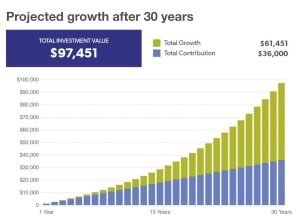
Here’s what investing $100 a month might add up to over the course of your career:
Note: this is an illustrative example; see how your savings can stack up over time with our Investment Growth Calculator.
No matter your gender or where you are on your financial journey, developing financial literacy is one of the most important investments you can make, enabling you to make informed decisions, build confidence, and create a stronger financial future.
Connect with us to build a personal financial plan that puts you in control
The above chart is for illustrative purposes and assumes a constant annual rate of return at 6%. Actual market performance will fluctuate.
Sources:
https://www.otpp.com/en-ca/members/life-events/time-off-work-and-how-it-affects-your-pension/
https://www.otpp.com/en-ca/members/life-events/time-off-work-and-how-it-affects-your-pension/buyback-cost-and-payment-options/
https://www.ncdv.org.uk/signs-of-domestic-abuse-violence/signs-of-domestic-abuse-violence/
https://nupge.ca/wp-content/uploads/2024/03/The-Cost-of-Being-a-Woman.pdf
https://canadianwomen.org/blog/debt-struggles-create-burden-of-poverty-for-women/
https://www.bankofcanada.ca/2024/07/staff-analytical-note-2024-18/
https://jobbank-guichetemplois.service.canada.ca/SectoralProfiles/ON/2022/2022-2024EducationalServices_FinalE.pdf
https://news.ok.ubc.ca/2025/07/02/what-credit-card-habits-reveal-about-canadian-households/
https://onlinelibrary.wiley.com/doi/full/10.1111/ijcs.70031?msockid=1e53cea17a36655c35c5d86b7b9964ff
https://www.statista.com/statistics/443342/single-parent-families-in-canada/
https://www.statcan.gc.ca/o1/en/plus/7574-diversity-families-canada
https://www.statcan.gc.ca/o1/en/plus/7523-despite-progress-one-parent-families-headed-mothers-continue-face-labour-market
https://www.ipsos.com/en-ca/43-canadians-need-debt-help-exploring-gaps-financial-literacy-during-debt-literacy-month
https://www.weforum.org/stories/health-and-healthcare-systems/womens-health-in-numbers